Meet the artist
Sean Levon
Nash
“The paintings are mine. The prints are how you get one on your wall.”
From East Oakland to the streets of San Francisco.
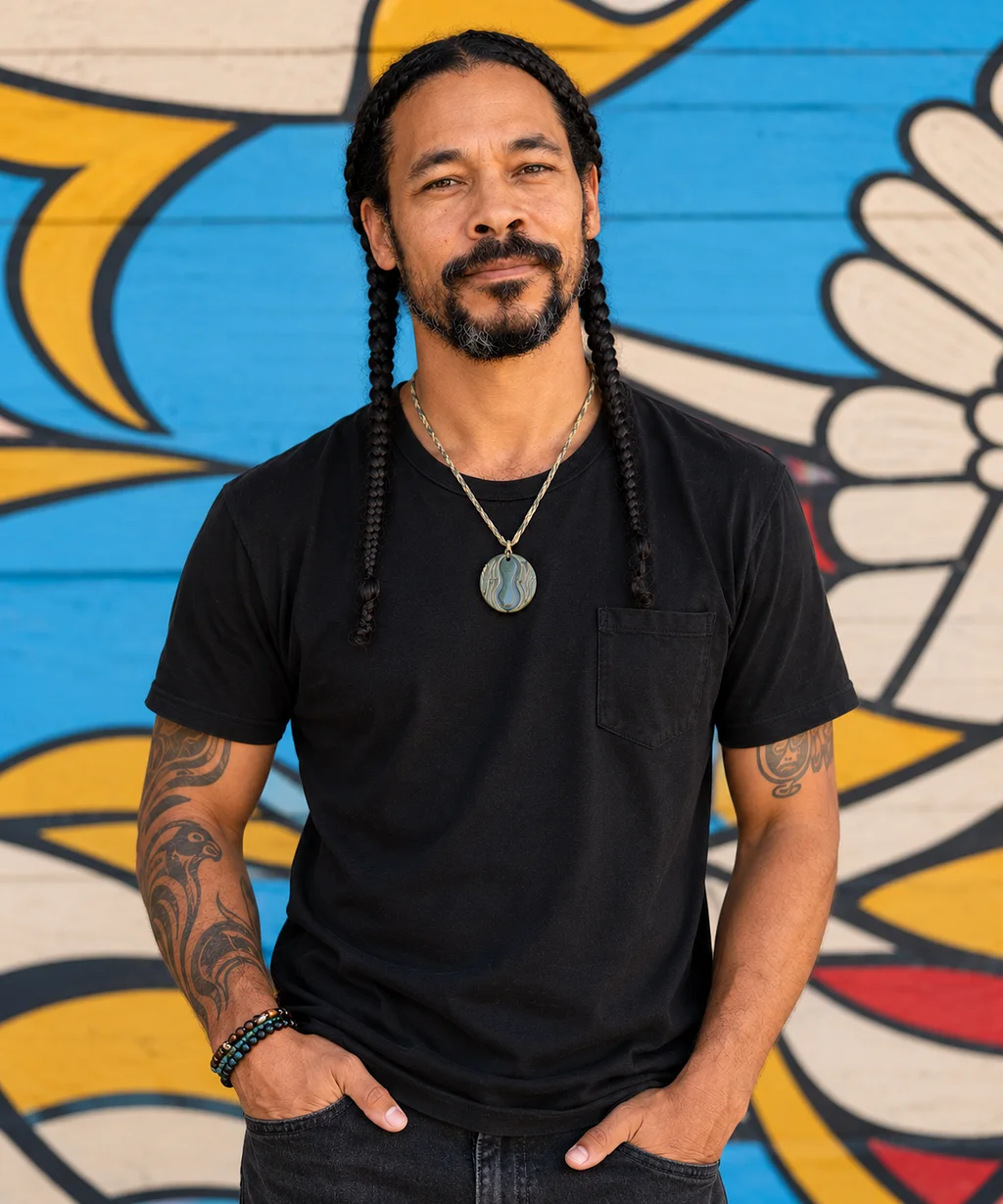
Why I make art
“Because I do not want to disappear.”
My ancestors fought to get me here. They bled and died and laughed and cried to give me a chance to survive, and after all that they went through, the least I can do is thrive.
Keep our culture alive. Promote it and share it. Defend it and spare it from erasure.
I'm originally from East Oakland, then studied art and history at UC Davis. By the time I got out, the dot-com bubble was blowing up the rents in Oakland, so I ended up in San Francisco's SOMA district and then the Mission, which at the time was still a low-income neighborhood.
That is where I first started selling my paintings in the street, in the late 90s. There was a mainly Chicano vibe, and a receptive audience for my explorations into pre-Columbian art of Mexico and Central America and my Día de los Muertos paintings.
Soon after, I started vending at local festivals like Carnaval, craft fairs, and alternative venues from cafes to small businesses all over the Bay Area. I went on the road up and down the coast and did some visiting lectures at schools and universities. Through collaboration with other local artists, I ended up doing some writing and color for an animated short, which was selected for the Sundance Film Festival.
Deciding to fulfill my lifelong aspiration to go to art school led me to the graduate program in Painting at the San Francisco Art Institute. There I had a community of other artists to work with, and the mentorship I needed to take the work further.
After graduating in 2008 I started teaching art history at Laney College, then landed an adjunct position at California College of the Arts, where I developed classes in Diversity Studies and taught in the Core program.
An interview with Sean
In my own words.
Selected excerpts from my artist statement, on cultural memory, making art, and the people who keep it alive.
What is your work about?
Dedication to the preservation of our cultural legacy, embracing the philosophy of our aesthetic, and representing a transition into the future so that other Native artists have a pathway to follow and non-Natives can learn to appreciate the richness of our contributions to the world.
Where does the work come from?
I am a Renaissance Indian. I gain my identity not through the history of my tribe alone, but through the intersectionality of Native peoples here and around the world. My area of special concern as a Native historian is with art of the Southeast mound builders, the Southwest Pueblo dwellers, and the Northwest longhouse people.
My historical investigations into the ancient art of Native America (namely the Maya, Aztec, and Inca civilizations) are a further attempt to contextualize the history of the work that was made in Native America, and I have discovered many connections between these groups. I emphasize the intersectionality of those overlapping connections, and I trace the development of cultural styles and aesthetic traditions from the past and into the present, pointing towards the future.
What is your philosophy of making art?
Use the tools appropriate for your situation and learn as many tools as you can to be a handyman. I’m like a studio musician in the visual arts. I don’t have an aesthetic preference for one style over another, though I have favorites.
I love punk rock and its antiauthoritarian vigor—and I love to hear a DJ rock the crowd and promote something bigger. We need to make art for other artists to promote our form, but it is important to remember the audience that we hope to inspire and inform. We can live in a space in between—a new American dream.
What does your audience mean to you?
I think my audience has come to expect me to push the boundaries of accessibility and information sharing. I feel mad love from my people, and every time I have a chance to exhibit in a formal or informal setting, I feel affirmed, validated, and reminded that I am not alone and that our culture has a value worth preserving, celebrating, and sharing.
Eternal thanks and gratitude for your time and energy.
Mitakuye Oyasın (All My Relations)
Yakoke (Give Thanks)—Sean Levon Nash
What’s next